
Not long ago, holidays were simple.
A break from work. A few days by the pool. A quick escape before returning to normal life on Monday. Simple.
But something has shifted.
For many professionals today, travel is no longer just about escape. It’s about recovery too.
Burnout has quietly become one of the biggest reasons people book surf and yoga retreats. Busy professionals arrive exhausted, overwhelmed and constantly connected to work. A week later, they leave with a clearer mind, a calmer nervous system and a different perspective on how they want to live.
In many cases, the retreat becomes more than a holiday. It becomes a turning point.
The reason for this is simple: burnout isn’t rare anymore. It’s pervasive.
Across industries and countries, professionals are reporting higher levels of stress, exhaustion and mental fatigue than ever before.
Which is why understanding burnout has become so important.
Burnout has become a global problem
Burnout is no longer just a buzzword used to describe a stressful week.
The World Health Organization now recognises burnout as an occupational phenomenon caused by chronic workplace stress that hasn’t been successfully managed.
And the numbers behind it are striking.
Studies show:
- 77% of professionals report experiencing burnout at their current job (Deloitte)
- 23% of employees say they feel burned out at work very often (Gallup)
- Workplace stress is now one of the leading causes of mental fatigue worldwide
The reasons are familiar to most busy professionals:
- Constant digital connection
- Long working hours
- High performance expectations
- Endless notifications
- Blurred boundaries between work and personal life
And when burnout grows, the way people travel changes
Because of this, we’ve discovered that travel is evolving.
People aren’t just booking holidays anymore. They’re looking for experiences that help them feel better when they return home.
Instead of passive relaxation, travellers are choosing trips that actively support recovery.
That often means:
- Time in nature
- Movement and physical activity
- Digital distancing (huge!)
- Connection with new people
- Space to slow down
This shift is one reason wellness travel has grown into a global industry worth more than 800 billion dollars. But within that trend, a specific type of travel is gaining momentum: surf and yoga retreats.
They combine movement, nature and community in a way that naturally helps the body and mind reset.
Which is why surf and yoga retreats are becoming so popular
Surf and yoga retreats offer something modern professionals rarely experience in everyday life: rhythm.
Days are structured around natural energy cycles rather than deadlines.
A typical retreat day might include:
- Morning surf sesh as the sun rises
- Breakfast with other guests
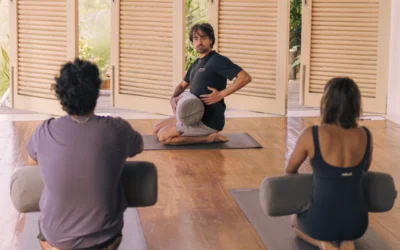
- Yoga sessions in a leafy, relaxing shala
- Time to relax by the pool or beach
- Afternoon movement, breathwork or meditation
- Shared dinners and conversations in the evening
The structure is simple, but powerful.
You move your body. You spend time in the ocean. You breathe more deeply. You disconnect from constant digital stimulation.
Within a few days, most people notice the same shift. Your shoulders relax. Sleep improves. Your mind quiets down.
You begin to remember what balance feels like.


And the ocean plays a bigger role than people realise
There’s also growing research behind the benefits of ocean environments.
Scientists studying “blue spaces” have found strong links between time spent near the ocean and improved mental wellbeing.
Some interesting findings include:
- People living near the coast report better mental health than those inland
- Spending two hours a week in nature significantly improves wellbeing
- Ocean environments can lower stress levels and improve mood
The ocean changes how the body feels.
- The sound of waves slows breathing
- Salt air encourages deeper breaths
- The horizon creates a sense of perspective
For professionals used to crowded cities and office environments, that experience can feel surprisingly powerful.
In fact, many retreat guests tell us that they haven’t slowed down like that in years!
Then movement helps release the stress stored in the body
Burnout doesn’t only affect the mind. It’s deeply physical.
Chronic stress keeps the body in a constant “fight or flight” state. Over time, this drains energy, affects sleep and reduces focus. Movement helps release that tension, whether it’s through yoga or surfing.
Yoga supports recovery by encouraging:
- Controlled breathing
- Slow, intentional movement
- Awareness of the body
- Nervous system regulation
Surfing, on the other hand, has your attention completely focused on the present moment. You’re thinking about:
- Balance
- Timing
- Positioning in the water
- The movement of the ocean
Trust us. When you’re surfing a wave, walking down the beach at sunset or deep into a yoga sesh, emails and deadlines are the last thing on your mind!
Then something unexpected happens. People reconnect
One of the most surprising parts of retreats is the sense of connection that forms between guests. That’s because one of the lesser-known facts about burnout is that it feels isolating.
Professionals often feel pressure to keep performing even when they’re exhausted. Many people rarely talk openly about how overwhelmed they feel.
But retreats create a different environment. Guests share experiences throughout the week:
- Yoga classes
- Surf lessons
- Meals
- Quiet moments by the ocean
- Conversations that stretch long into the evening
People who arrive as strangers quickly become friends.
For many guests, it’s the first time they’ve had honest conversations about stress, life direction and what they actually want from the future.
That shared openness is incredibly powerful. And we love seeing guests who’ve never met before bond over shared experiences in a healthy, supportive setting.
Which is how the retreat becomes a turning point
To say a retreat is life-changing can feel very cliché. We get it. But that doesn’t mean it isn’t true.
For many people, a surf and yoga retreat is a chance to recover from burnout and return home feeling refreshed. But occasionally something bigger happens.
Stepping away from routine creates space for reflection.
Guests start asking themselves questions they haven’t had time to consider before:
- Why am I constantly this stressed?
- Do I want to keep living this way?
- What would life look like if I prioritised balance?
Sometimes the answers lead to real change.
Some guests adjust their careers. Others move closer to the ocean (and even get jobs with us!). Some simply start prioritising health, movement and time in nature.
The retreat becomes the moment where things evolve.
Which explains why this style of travel is growing so quickly
Modern life isn’t slowing down.
If anything, work culture is becoming faster and more connected than ever. But people are beginning to push back against that pace. Hustle culture is being replaced by rest as a form of rebellion.
Instead of simply escaping stress for a few days, many travellers are now seeking experiences that help them reconnect with themselves. And you know what? Surf and yoga travel sit perfectly within that shift.