Type “Lombok surf lessons” into Google and you’ll find dozens of surf schools promising to get you standing up on your first wave.
And to be fair, many of them probably will.
But after years of running surf coaching programmes in Lombok, we’ve noticed something interesting. The people who leave feeling genuinely confident aren’t necessarily the ones who spent the most hours in the water. They’re the ones who spent their time surfing the right waves, with the right coaching, at the right stage of their progression.
That’s why we wanted to write this guide.
Not to tell you where to book. There are plenty of great instructors in Lombok. Instead, we want to help you understand what makes a surf lesson worthwhile, what you should expect when learning here, and how to choose an experience that matches your goals.
Whether you’re catching your very first whitewater wave or you’re looking to move beyond the basics, Lombok is one of the best places in Indonesia to learn. It has a huge variety of waves, warm water all year round and, unlike many destinations, enough different surf breaks that it’s usually possible to find something suitable for your level.
The challenge isn’t finding waves.
It’s finding the right waves.
What are surf lessons like in Lombok?
One of the biggest surprises for many visitors is that surfing in Lombok isn’t quite the same as surfing in places like Canggu or Kuta, Bali.
Many of the island’s best beginner and intermediate waves are reef breaks. Before that sounds intimidating, it’s worth remembering that a reef break isn’t automatically difficult. Plenty of Lombok’s reefs are soft, forgiving and perfect for learning, especially when they’re surfed at the right tide.
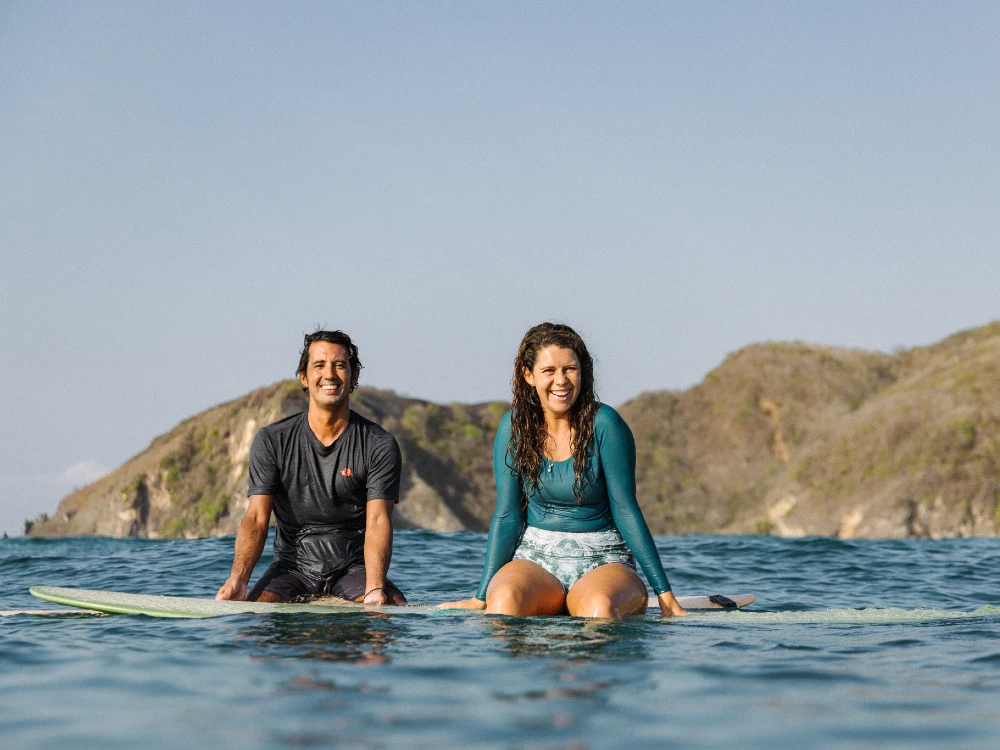
You’ll usually reach these waves by local fishing boat. For many people, that’s part of the experience. A ten-minute boat ride, crystal-clear water, incredible views of the coastline and then a lineup that’s often less crowded than many famous surf destinations.
A typical lesson lasts around two hours in the water. Your instructor will help carry your board, choose where to surf based on the conditions that day, and give feedback between waves. Most schools also include the board, a rash vest and transport to the beach.
The quality of the lesson, however, has surprisingly little to do with how long you’re in the water.
We’ve seen guests make huge progress during a single session because the conditions were perfect for their level. We’ve also seen people spend two hours battling waves that were simply too big or too fast to learn much at all.
That’s one of the reasons local knowledge matters so much in Lombok. There are dozens of surf breaks within a relatively small area, and knowing which one to choose each day often makes a bigger difference than anything else.
The best surf lesson isn’t always the longest one
One of the biggest misconceptions about learning to surf is that improvement simply comes from spending more hours in the water.
We’ve seen people surf for four hours in challenging conditions and finish the session exhausted, frustrated and no more confident than when they started. We’ve also seen guests have a breakthrough during a single ninety-minute session because everything aligned: the waves suited their ability, the conditions were calm, and the coaching helped them understand what they were doing rather than simply repeating attempts.
That’s why choosing the right wave often matters more than squeezing in another hour.
In Lombok, tides, swell direction and wind can completely transform a surf break. A wave that’s perfect for beginners in the morning might be unsuitable a few hours later. Knowing where to go, and when, is one of the biggest advantages of surfing with experienced local coaches.
Learning to surf isn’t about finding the biggest wave or spending the longest time in the ocean.
It’s about giving yourself the best opportunity to catch good waves consistently.
Private or group surf lessons?
People often assume that private lessons are always the best option.
In reality, it depends less on whether you’re surfing one-on-one and more on how much attention you’re actually getting in the water.
Some group lessons can have one instructor looking after six, eight or even more students. In those situations, it’s only natural that you’ll spend a fair amount of time waiting for feedback or watching others take their turn.
At the other end of the spectrum, a private lesson gives you your instructor’s full attention from start to finish. If you have very specific goals or already know exactly what you want to work on, that can be a great option.
At Xanadu, we’ve chosen a slightly different approach.
Although our surf sessions are run in small groups, we keep our instructor-to-surfer ratio at one instructor for every two guests. That means you’ll never find yourself in a large group competing for your coach’s attention. Instead, you get the best of both worlds: plenty of individual feedback and coaching, while still enjoying the motivation and camaraderie that comes from surfing alongside others at a similar level.
We’ve found this creates a more enjoyable learning environment. Guests encourage one another, celebrate each other’s progress and often leave with new surf buddies, while still receiving the kind of personalised coaching that’s difficult to achieve in larger groups.
For us, it’s not about choosing between private and group lessons.
It’s about making sure every surfer gets the attention they need to progress with confidence.
How many surf lessons do you actually need?
This is probably the question everyone wants the answer to. Unfortunately, there isn’t one.
Some people are standing up and riding whitewater within their first hour. Others need two or three sessions before everything starts to click. Neither is better than the other.
Surfing isn’t just about balance. You’re trying to read a constantly moving ocean, time your take-off, control a board that’s being pushed by moving water and remember a dozen small things your instructor has just explained – all at once. It’s a lot of moving parts.
The biggest improvement usually happens between your third and fifth session. That’s when paddling starts to feel more natural, popping up requires less thought and you begin looking at the wave instead of your feet.
For complete beginners, we’d generally recommend at least three or four consecutive days of surfing if your goal is to build confidence rather than simply tick surfing off your bucket list.
If you’ve already surfed before and can consistently catch whitewater, you may find that a few well-coached sessions are enough to start working on your first green waves.
The key word is consistent.
A lesson on Monday and another three weeks later isn’t really building on anything. Surfing rewards repetition.
The mistakes we see beginners make most often
After years of coaching surfers of all levels, the same patterns appear again and again.
The first is rushing.
Many people become fixated on surfing bigger waves as quickly as possible. In reality, progressing too early often slows improvement. Smaller, forgiving waves give you more opportunities to practise the fundamentals, and those fundamentals are what eventually allow you to surf bigger waves with confidence.
Another common mistake is comparing yourself to everyone else in the lineup.
Every surfer arrives with a different background. Some grew up swimming competitively. Others skateboard or snowboard. Some are naturally athletic, while others are simply determined enough to keep trying until things finally click.
Progress looks different for everyone.
Perhaps the biggest mistake, though, is thinking that surfing is all about standing up.
Standing up is only one tiny part of catching a wave. Positioning yourself correctly, choosing the right wave, paddling efficiently and understanding what the ocean is doing are far more important in the long run.
Ironically, once those pieces come together, standing up usually becomes much easier.
What should you bring to a surf lesson?
The good news is not much.
Most surf schools in Lombok provide the board, leash and a rash vest, so you’re really just bringing yourself.
A few things we always recommend packing are:
- Reef-safe sunscreen. The tropical sun is stronger than many visitors expect, even on cloudy days.
- A reusable water bottle. Surfing is surprisingly physical and staying hydrated makes a noticeable difference.
- A towel and dry clothes for afterwards.
- A waterproof bag if you’re travelling with valuables.
- Plenty of patience.
That last one isn’t a joke.
Some days everything seems effortless. Other days the ocean feels like it’s working against you. Both are part of learning.
When is the best time to take surf lessons in Lombok?
People are often surprised when we tell them there’s no single “best” season.
Lombok has waves all year round.
The dry season, generally from May to October, brings consistent swell and offshore winds to many of the island’s famous breaks. It’s a fantastic time to surf, particularly if you already have some experience.
The wet season, roughly November to April, is equally enjoyable, just different.
Wind directions change, opening up a completely different selection of surf breaks. Some of our favourite beginner and intermediate waves come alive during these months, and it’s often possible to find beautifully clean conditions while other parts of Indonesia are battling onshore winds.
Rather than asking, “What’s the best month to learn?”, it’s usually more helpful to ask, “Which waves will suit my level while I’m there?”
That’s exactly what good local coaches consider every single day.
At Xanadu, we don’t think of surfing as a collection of lessons
People often ask whether we offer surf lessons.
The answer is yes, but probably not in the way they’re imagining.
We don’t run individual walk-in lessons because that’s never been what we’re passionate about.
Instead, we’ve built week-long surf coaching programmes where each session builds on the previous one.
One day you’ll work on paddling and wave selection. The next, you’ll review video footage from your session and understand why one take-off worked while another didn’t. Between surfs, you’ll learn how tides affect different breaks, how to read a forecast, and how mobility and recovery can help you feel stronger in the water the following day.
We’ve found that this approach gives people something much more valuable than a successful surf lesson.
It gives them the confidence to keep surfing long after they’ve left Lombok.
Some guests arrive worried they’ll never stand up. A week later they’re reading the lineup themselves, choosing waves independently and already planning their next surf trip.
For us, that’s what learning to surf is really about.
Final thoughts
Lombok is an incredible place to learn.
The warm water, variety of waves and experienced local surf community make it one of the most rewarding destinations in Indonesia, whether you’re catching your first wave or trying to take your surfing to the next level.
When choosing surf lessons, don’t focus solely on price or how many hours you’ll spend in the water.
Look for people who genuinely care about your progression, who understand the local conditions and who are willing to adapt each session to your ability.
Because the best surf lesson isn’t necessarily the one where you catch the most waves.
It’s the one that leaves you excited to paddle back out tomorrow.
Frequently Asked Questions
Are surf lessons in Lombok suitable for complete beginners?
Yes. Lombok has several beginner-friendly waves, and with the right instructor and conditions, many people catch their first waves here. Choosing the right surf break for the day’s tide and swell is far more important than simply choosing the closest beach.
Is Lombok better than Bali for learning to surf?
Both are excellent destinations, but they’re quite different. Bali offers countless surf schools and easy access to beach breaks, while Lombok generally still feels quieter and has a wider variety of long mellow reef breaks suitable for different abilities.
How long does it take to learn to surf?
Most beginners can stand up on whitewater within their first few lessons. Feeling comfortable catching and riding unbroken green waves usually takes longer and depends on consistency, coaching and ocean conditions.
Do I need to be a strong swimmer?
You should be comfortable swimming in open water. You don’t need to be an elite swimmer, but confidence in the ocean is essential for your own safety and enjoyment.
What is included in most surf lessons?
Most lessons include a surfboard, leash, rash vest, instructor and transport to the surf break if required. Some coaching programmes also include video analysis, surf theory and mobility sessions to help accelerate your progression.